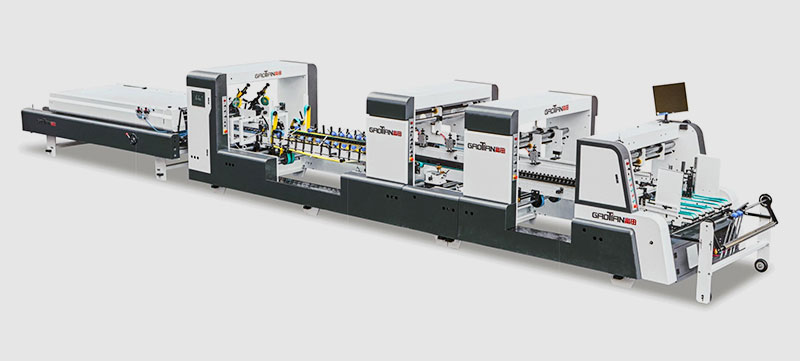
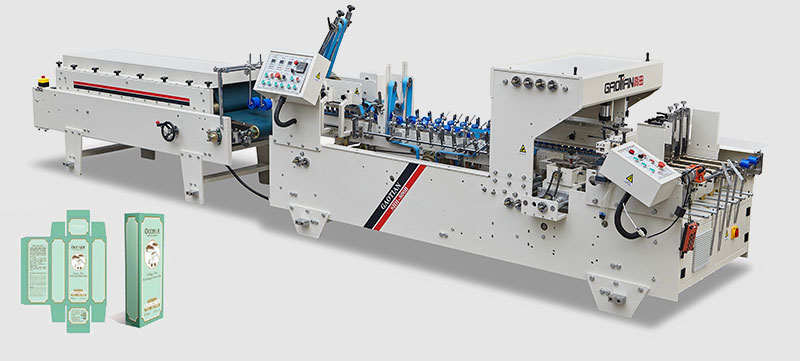
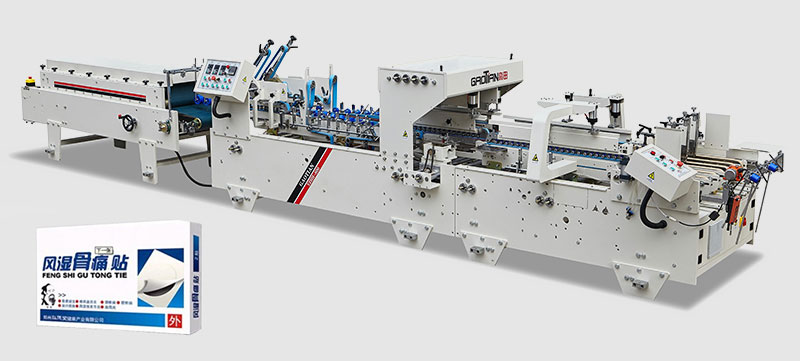
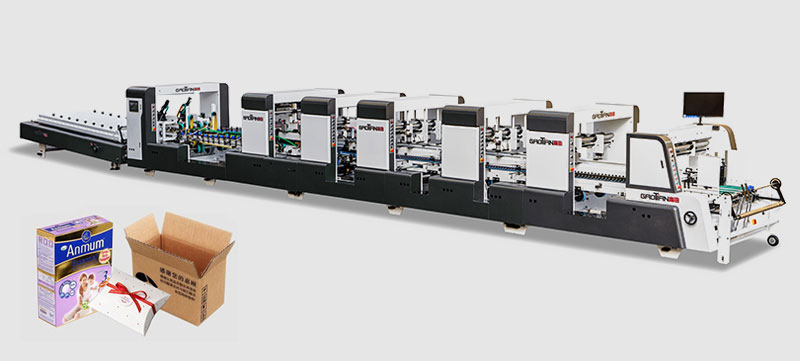
Automatic Folder Gluer Machine for Folding and Gluing Carton Boxes
Gaotian manufactures automatic folder gluer machines for printing and packaging production enterprises. Our machines process die-cut or slotted paperboard blanks through feeding, folding, gluing, pressing and delivery to produce finished cartons. Configurations available include straight-line, pre-fold and lock-bottom models, covering box styles for food, pharmaceutical, cosmetic and retail packaging applications. Whether you are running 200 GSM cardstock or E-flute corrugated board, there is a Gaotian model configured for your production requirements. Request a machine recommendation or send your box drawing for a configuration assessment.
What Is an Automatic Folder Gluer Machine?
An automatic folder gluer machine converts die-cut or slotted paperboard blanks into finished cartons through feeding, folding, gluing, pressing and delivery. The correct configuration depends on box style, board thickness, production speed and required folding sequence.
The automatic folder gluer machine is the final machine in the folding carton production process, positioned after printing and die-cutting. It transforms flat printed and die-cut carton blanks into finished, collapsed cartons that ship to packers ready for opening, filling and sealing. Gaotian's machines integrate mechanical transmission, precise positioning, and intelligent gluing technology to achieve full automation of the cardboard conveying → folding and forming → gluing and pressing process.
-
High stability: Reduce manual intervention and ensure production continuity.
-
Efficient production: Suitable for batch packaging scenarios in industries such as food, pharmaceuticals, cosmetics and electronics.
-
Cost optimization: Standardized processes improve quality consistency and reduce production costs.
-
Material compatibility: Supports multiple materials such as cardboard, white board and coated paper. Adaptable to multiple box types including folding boxes, gift boxes, color boxes and transport boxes.
This page covers the full product family.If you are specifically evaluating folder gluer for cardboard box,see the dedicated Folder Gluer for Cardboard Box pillar page.For corrugated box,refer to the Folder Gluer for Corrugated Box series and Heavy-duty Folder Gluer for Corrugated Box series.

How an Automatic Folder Gluer Machine Works
The machine operates as a continuous, synchronized production line. Each stage must be calibrated to match the specific box style, board material and adhesive system being used. Below is the five-stage workflow, with the key quality factor and common operational issue for each.
Step 1: Feeding
Function: Carton blanks are loaded into the feed magazine and advanced individually and successively into the machine. The feeding mechanism uses timed feed means to separate and forward each blank at a consistent interval, ensuring proper registration for downstream folding and gluing.
Key quality factor: Feed timing and vacuum pressure. Inconsistent feeding is a leading cause of downstream misalignment and jams.
Machine structure: Vacuum paper feeding section, feed belts, guide rails and adjustable gate.
Common anomalies: Frequent sheet-feeding problems, double feeds, or blanks skewed before entering the folding section.
Step 2: Alignment and Pre-folding
Function: The blank is aligned laterally and pre-folded along crease lines. Pre-fold is essential for boxes that will be opened and filled on automatic packaging lines — it ensures the crease memory is set so the carton opens reliably. The YZHH Automatic Pre-fold Folder Gluer Machine is a dual-board structure with pre-fold knife set designed specifically for this application, with fold 1 and fold 3 reaching 180° and 135° respectively. For combined pre-fold and lock-bottom production, the SHH-AG Automatic Pre-fold and Lock Bottom Folder Gluer Machine exchanges fold 1 and fold 3 between 180° and 150°.
Key quality factor: Fold accuracy and crease-line registration. Misalignment here propagates through every subsequent stage.
Machine structure: Pre-folding unit with adjustable folding belts, crease-breaking rollers, and left/right guide plates.
Common anomalies: Variations in manufacturer's gap, fishtailing, crease fracture, or incorrect box formation sequence.
Step 3: Glue Application
Function: Adhesive is applied to the glue flap or designated glue points. Two adhesive systems are common: hot melt adhesive (EVA-based) applied at 160–175°C with an open time of 2–5 seconds, and cold glue (PVA/white glue) applied at room temperature with an open time of 20–60 seconds.
Key quality factor: Glue temperature, roller gap and nozzle alignment. The glue wheel-to-scraper gap is typically controlled at 0.05–0.10 mm, equivalent to the thickness of an 80 GSM coated paper. For diagnostic procedures on gluing faults, see the Glue Problem Troubleshooting guide in our news section.
Machine structure: Glue wheel, scraper plate, glue tank or hot melt applicator, spray nozzles for pattern gluing.
Common anomalies: No glue or intermittent glue, excessive glue, incorrectly timed glue, incorrect lateral position, or glue carbonization at temperatures exceeding 200°C.
Step 4: Folding and Compression
Function: The glued panels are folded and pressed together. The compression section holds the joint under controlled pressure while the adhesive cures sufficiently for the bond to survive transport and downstream handling. A pressing mechanism presses the connecting portions of the first and fourth panels after they are folded to 90° and before being folded to 180°.
Key quality factor: Compression pressure, duration and belt tension. Corrugated boxes require approximately 30% higher pressure than cardboard boxes. For high-speed operation, the compression section may need to be extended or the line speed reduced by 10–15% to allow proper adhesive setting.
Machine structure: Folding belts and carriers, compression rollers, trombone section with automatic belt tension-adjusting system, pressing plates.
Common anomalies: Boxes opening after production, inadequate bond, board damage from excessive pressure, or bond failure on coated or UV-varnished surfaces. For corrugated lock-bottom applications specifically, the SHH-E Automatic Corrugated Lock Bottom Folder Gluer Machine uses servo-controlled, high-strength belt drive to maintain consistent compression on thicker board grades.
Step 5: Counting and Delivery
Function: Finished cartons are counted and delivered in a shingled stream to the collection pile. Automatic counting and kicking mechanisms maintain a consistent batch size for downstream packing or shipping.
Key quality factor: Delivery alignment and batch count accuracy.
Machine structure: Counting device, delivery conveyor, kicker, trombone section.
Common anomalies: Misaligned delivery causing pile instability, inaccurate counts, or jams at the transfer point.
For a visual walkthrough of the folding and gluing process, see the machine operation clips on our Video page.

Carton Types and Application Scenarios
| Box Type | Description | Typical Applications |
|---|---|---|
| Straight-line box | Simplest carton style with a single glue flap; four panels fold along parallel crease lines. | Food packaging, daily chemical products, pharmaceuticals, general retail packaging |
| Pre-fold box | Crease lines are pre-folded beyond 90° so the carton opens easily on automatic packaging lines. | Folding cartons requiring fast erection; secondary packaging on automated fill-and-seal lines |
| Lock-bottom (crash-lock) box | Bottom panels interlock mechanically without glue at the base; requires pre-folding of bottom flaps. | Cosmetics, food, and heavier products needing a strong, self-locking base |
| Corrugated carton | Heavier board construction with E, B, or C flute; provides higher structural strength. | Transport packaging, electronics packaging, thicker board applications |
Gaotian's automatic folder gluer machines process cardboard from 200–800 GSM and corrugated board in A, B, E and F flute grades. The correct box style determines which machine model and configuration will deliver acceptable output.
Model Selection Matrix
The table below maps Gaotian's folder gluer models to application scenarios. Select the model family that matches your primary box style and production volume, then refer to the individual product pages for full technical parameters. Final specifications must be confirmed against the technical parameter sheet for each model to avoid inconsistency between the pillar page and product pages.
| Model | Best For | Key Feature |
|---|---|---|
| SHH-B | General-purpose straight-line box production | Flexibility and versatility; handles cardboard 220–800 GSM and E-flute corrugated. Line speed 0–220 m/min. |
| SHH-B2A | High-speed straight-line box production | Continuous high-speed output. Max line speed 220 m/min. Power 11.5 KW 380V 50HZ 3P. Available in 1050/1250/1450/1650/1850/2050 widths. |
| SHH-HX | High-speed corrugated carton production | Designed for maximum throughput on corrugated board. |
| SHH-AG | Pre-fold and lock-bottom box production | Accommodates multiple straight-line and bottom-lock box styles with combined pre-fold and lock-bottom functions. |
| SHH-E | Corrugated lock-bottom box production | Servo-controlled, high-strength belt drive for demanding corrugated lock-bottom applications. |
| YZHH | Pre-fold box production | Dual-board structure with pre-fold knife set; produces cartons that open easily on automatic packaging lines. |
Important: The speed, board thickness, and dimension ranges shown above are indicative. Actual values vary by model width and configuration. Always verify against the current technical parameter table before specifying or purchasing.
Pre-Purchase Checklist: Information Required for Quotation
A credible folder gluer quotation requires specific technical inputs. Without these, a quoted figure may describe a different configuration and should not be treated as a reliable purchase basis. Prepare the following information before contacting a supplier:
Box Specifications
-
Box style — Straight-line, pre-fold, lock-bottom, or corrugated
-
Flat blank size — Minimum and maximum dimensions in mm
-
Board material and thickness — GSM for cardboard, flute type for corrugated
-
Folding sequence — Required fold order and angles
-
Minimum and maximum box size — Finished dimensions
Production Requirements
-
Required production speed — Meters per minute or pieces per hour
-
Glue type — Hot melt, cold glue, or pattern gluing
-
Order mix — Quantity per order and changeover frequency
-
Current die-cutter output — Upstream capacity in good pieces per shift
-
Operator plan — Number of operators and required automation level
-
Required automation level — Manual, semi-automatic, or fully automatic
Site and Infrastructure
-
Available floor space — Installation footprint and service clearance
-
Utilities — Power supply, compressed air, and adhesive supply
-
Board infeed and carton outfeed route — Material flow
-
Upstream and downstream integration — Die-cutter, packer, or strapper
Samples and Documentation
-
Three reference products — One high-volume job, one large or demanding job, and one frequent-change job
-
Box drawing — Open dimensions, finished dimensions, crease lines, glue flap, and flute direction
-
Board sample — Actual production board for test runs
For a structured decision process covering these factors, see the Folder Gluer Selection Guide on our About Us page.
Key Technical Parameters
The following table lists the structured technical parameters that define an automatic folder gluer machine configuration. Values shown are typical ranges for Gaotian models. Confirm exact specifications with the technical parameter sheet for each model.
| Parameter | Specification Range | Notes |
|---|---|---|
| Maximum belt speed | 0–220 m/min (SHH-B, SHH-B2A); up to 250 m/min (SHH-FS) | Speed varies by model and box style; lock-bottom and 4/6-corner boxes run at lower effective speeds |
| Board thickness | 200–800 GSM cardboard; E, B, C flute corrugated | Thinner boards may require reduced speed to maintain fold accuracy |
| Minimum blank size | Varies by model width; typically from 50 × 50 mm | Check individual model specifications |
| Maximum blank size | Up to 2,050 mm width for widest models | Determined by model width designation |
| Applicable paperboard type | Cardboard, white board, coated paper, corrugated board | Coated or UV-varnished surfaces may require surface preparation or specialized adhesive |
| Folding accuracy | ±0.5 mm typical | Depends on blank quality and machine calibration |
| Glue system | Hot melt (160–175°C) or cold glue (PVA, room temperature) | Pattern gluing with spray nozzles optional |
| Motor and control system | PLC variable frequency drive; independent motor control per section | Some models offer servo-driven sections |
| Machine dimensions | Varies by model width and configuration | Confirm installation footprint with supplier |
| Power requirement | 11.5 KW 380V 50HZ 3P (SHH-B2A typical) | Higher for wider models and additional sections |
Note: These parameters are representative of the Gaotian product family. The specific values for any model must be confirmed against the official technical parameter table. Do not specify a machine solely based on the ranges shown here.
Installation, Commissioning and After-Sales Support
Factory Acceptance
Before shipment, the machine is assembled and tested at the factory. Buyers are encouraged to witness a trial run with their own board samples and box drawings to verify fold accuracy, glue application and output rate against the agreed acceptance criteria.
Installation Preparation
The buyer is responsible for preparing the installation site, including foundation, power supply, compressed air, and adhesive supply lines. The supplier provides detailed site preparation drawings and requirements before delivery.

Operator Training
On-site operator training covers:
-
Machine setup and adjustment for different box styles
-
Adhesive system operation and temperature control
-
Fold guide and compression plate calibration
-
First-article inspection procedure
-
Daily maintenance and cleaning
-
Troubleshooting common folding and gluing faults
Trial Production
After installation, a trial production run is conducted with the buyer's actual production boards and box specifications. Acceptance is based on documented criteria: fold tolerance, glue-line condition, joint opening, misalignment, board damage, and allowed waste.
Spare Parts
A recommended spare parts package is available, covering wear items such as belts, glue wheels, scrapers, and folding guides.
Remote Technical Support
Remote support via video call and remote diagnostics is available for troubleshooting and parameter adjustment between on-site visits.
Maintenance Schedule
A preventive maintenance schedule is provided covering daily, weekly, monthly, and annual tasks, including belt tension checks, glue system cleaning, and calibration verification.
For full contact details, including telephone, email and office address, visit our Contacts page.
FAQ
1. Will the machine run off-track at high speed?
Our machines excel at stable forming even at high speeds. Equipped with 15 imported machining centers, we guarantee high precision of all components for steady operation.
2. Can the flared mouth issue be fixed?
We adjust belt tension, deviation-correcting wheel angles and box pressing length during commissioning to ensure balanced feeding, synchronized folding and precise creasing. Our machines perform excellently in controlling flared mouths especially at high speed.
3. Are you a trading company or manufacturer?
We are a professional folder gluer manufacturer with independent machining workshops, assembly plant, sales and after-sales teams.
4. Where is your factory located?
Our factory is in Ouhai District, Wenzhou, Zhejiang Province, China. The nearest airport is Wenzhou Longwan International Airport and the nearest high-speed railway station is Wenzhou South Railway Station.
5. What are your machines' biggest advantages?
Apart from high running speed, our machines feature outstanding stability, easy adjustment, strong adaptability to complex box types and durable high-speed performance, enabling long-term stable mass production of complicated boxes.
6. What is the general lead time?
Normally 30 to 45 days, subject to actual order conditions. We guarantee on-time delivery with reliable quality.
7. Can you run box tests?
Yes. Please send us sample boxes and we will conduct machine testing accordingly.
8. What about your after-sales service?
We offer on-site service upon negotiation plus video installation guidance, online machine adjustment and operational training. We ensure your smooth and stable production after purchase.
Internal Linking Structure
Product Model Pages